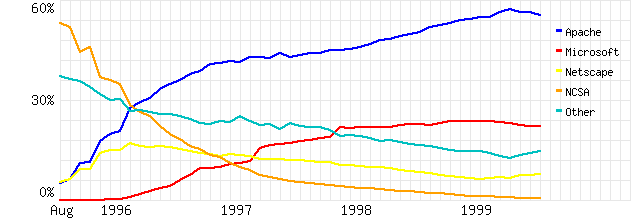
Question: "What is the current state of the Internet? Support your answer with data from surveys conducted."
This web page is going to define what the Internet is and the current state of the Internet in terms of host counts, revenue. It will attempt to depict where the Internet is at the moment and the possible future predictions.
IntroductionIn the current explosive growth of the Internet there is the opportunity to observe and examine the explosive growth of a very dynamic new industry, on a scale similar to the building of the English Channel tunnel, postal systems, telephone, railroad, and electrical infrastructure. To interpret the current state of the Internet and predict or extrapolate about its future lets look at the history and origin of the Internet.
The Background HistoryThe Internet is a global network of networks allowing all computers to directly and transparentl y communicate and share network services. The Internet is an is large in terms of networks and valuable, allowing capability for so many people and organizations, it also represents a shared global resource database of information, knowledge, and means of collaboration, and cooperation with many diverse group of people.
The most common way of measuring the internet traffic is to use ping: A test called "ping" is used to measure round-trip travel time along major paths on the Internet. We have several servers in different areas of the globe perform the same ping at the same time. Each test server then compares the current response to past responses from the same test to determine if the response was bad or good on a scale of 0 to 100. The scores from all test servers are averaged together into a single index.
The Internet referred back then to a network connecting roughly 11,000 smaller networks, hooked up together by phone lines and routers that direct and control the flow of the information. Founded in 1969 by the ARPANET U.S Department of Defense Advanced Research Project Agency, the Internet serve two objectives: Firstly to share resources and research among the military, industry sources and universities and secondly to maintain open communication in the event of nuclear attack.
Today, the Internet is basically a free self-regulating industry or network and is not controlled by governments or one single commercial entity. The Internet is providing the very popular useful applications for academics researchers, businesses and the general public meaning consumers:
The Internet is in its 11th year of annual doubling since 1988. There are over 44 million hosts on the Internet and an estimated 150 million users, world wide. By 2006, the Internet is likely to exceed the size of the global telephone network, if it has not by that time become the telephone network by virtue of IP telephony. Moreover, tens of millions of Internet-enabled appliances will have joined The Internet is for Everyone http://www.isoc.org/isoc/media/speeches/foreveryone.shtml
The number of users of Internet will likely reach over 300 million by the end of the year 2000, but that is only about 5% of the world's population. By 2047 the world's population may reach about 11 billion. If only 25% of the then-world''s population is on the Internet, that is nearly 3 billion users or ten times the population estimated at the end of the next year.
A Business Week survey in June 1996 on consumer experience with telecommunications revolution", only 19% of respondents suggested they have used the Internet or the World Wide Web in the past years. Back then the Internet was experiencing a phenomenal growth and the sample population survey was smaller than population today.
The number of worldwide Internet users tripled from 1993 and 1995 to roughly between 40 and 60 million. There will be a quarter-billion regular users by the year 2000. Roughly 100 countries now enjoy Internet access with 22 connected in 1995 alone. There were fewer than 30,000 Internet -connected computer networks 2 years ago. Today, there are more than 90,000. There were just 300 Internet host" computers in 1980. The 1996 number is more than 10 million. Four years from now, it will be 120 million.
The benefits of a computer network increases by an exponential factor of the number of computer host connected to it and the quantity of information on the Internet has already attained a critical mass. Every year it doubles. A Swiss Researcher established the World Wide Web in 1991. In 1992, it consisted of only 100 web sites. Currently more than 200,000 of web pages exist , with 11 million "pages" of information such as data, graphics, text, and sound. And the Web increases by 1.2 million every month.
The Internet has effectively reduced barriers to languages, technology and regulations. For example, In Japan the Internet has rapidly expanded into the household, from a education or academic research network for universities and private research institutes to one also providing resources and communications for individuals, businesses conducting electronic commerce.
In the Middle East region, Internet population has doubled. In a region known for its politically volatile conditions and still developing countries, the application of the Internet would come after social issues. But things have changed. Technology progression and cost reduces all the time , local consumers, business interests and governments are active in promoting the Internet as a beneficial way to conduct commerce. The establishment of Internet Service Providers ISPs, development of Arabic Local language web browsers and software applications, in addition increased growth from the consumers has facilitated the Internet expansion.
One indicator of Internet use is the survey performed by Network Wizards. The Domain Survey [The Domain Survey: click here to see table of data] attempts to discover every host on the Internet by doing a complete search of the Domain Name System. The number of hosts identified by country identifiers from the Arab League rose from 2797 in January of 1996 to 11209 in July of 1997. This increase of 300% is almost three times the rate for all hosts during the same period an increase of 106%.
The Internet market in Asia-Pacific has entered a strong growth phase that despite the recent economic difficulties faced by several economies in the region is still outpacing the rest of the world. The fast rate at which organizations in Asia-Pacific are adopting Internet technologies presents significant business opportunities for hardware manufacturers, software developers and service providers.
Supporting Evidence of Statistics
Without some hard evidence, the picture on the current state of the Internet is not explicity clear.
Below are a number of statistical information reference from information services organisation that
attempt to substantiate the arguments in the above
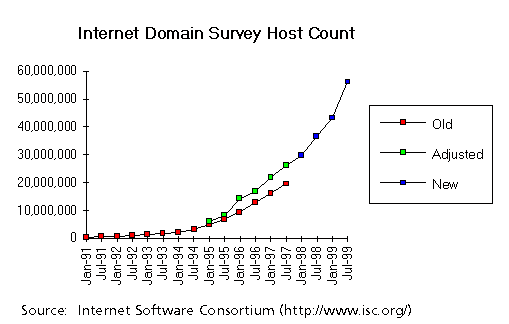
The survey cocluded that the Internet host numbers have rose sharply. It show a sharp jump in the number of host counts from 96� to 98� and this is because the more host mean increase in surge for Internet access and this growth indicate more users. Consequently a exponential effect is occurring. Eg host count graph
The Internet Operating System Counter (Source: Isocount) Another useful measure of the Internet usage is the operating systems count . The preference for operating system is a good indicator of Internet activity. Taken into account of OS is the cost and ease efficiency eg GUI. There are direct effects and indirect effect on the Internet connectivity depending on the host terminal. The user friendly of some operating system would imply Users have a far greater opportunity to accessing Internet content and hence further increase the Internet take up rate
References
This NUA graph depicted a dramatic count on the number of people online. This indicates the Internet has produced a global influence on many people�s lifestyle and these people are using it as their norm of communications. The most visible observation was that the US is dominating the user count. That is because the US are the pioneers of the Internet.
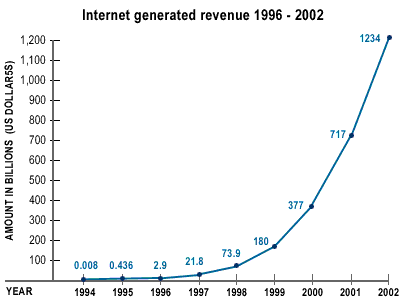
This particular NUA survey indicated that Internet generated revenue is growing. It grew to its peak in 1997 as a form as a sharp rise in revenue generated by 1998 of 73.9 billions US. An estimate projection on the revenue gives that it would be a serious medium for businesses to advertise on par with traditional media eg newspaper, magazine, radio, television.
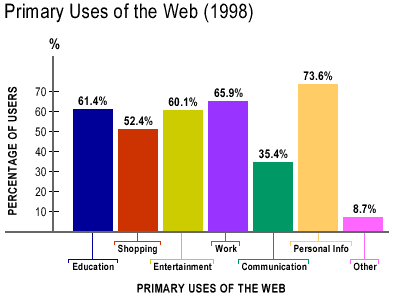
The Internet can be said to be a large information database repository. The second groups of users were work related users. As a result businesses have increased their use of the Internet for strategic information and advertising promotions.
 References:
 Gender Usage
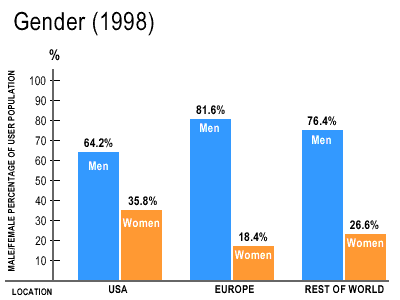
Technology is usually stereotyped or only associated with men and this was proven in the gender survey, also conducted by NUA. It seems that large number of men uses Internet as opposed to the small proportion of women. This was the case in all the three zones conducted.
Its obvious that the Internet is still heavily dominated by the North Americans wit 57% of the population in the NUA survey by location. Coming in second was European with 21.75%, trailed by Asia with 17%. Then South America with 13 %. The lowest take up of the Internet was in Africa and Middle East with 0.75% and 0.5% respectively.
ReferencesIt�s the same case here for the http://www.domainstats.com , North America makes up 5594889 of all domain name registrations worldwide of 9204278. Coming second was Germany with 391 113, then followed by UK 360 821 and Australia came in with 122201.
In conclusion .com domain names are the most popular form of domain name registraions
Domain Stats, 1999, Domain Name Registration: Click Here to View Graph: http://www.domainstats.com/
The Internet will be growing at a slower rate after 2000. That is according to MIDS a Internet monitoring service firm. MIDS newsletter distributed in May reported that the growth in the number of internet host eg computers attainable through DNS have been doubling for a decade has began to slow down dramatically. The measured annual growth rate of internet host has dropped from 100 % per year to just 60% per year.
This is because the United States have 64 % of the total population of internet hosts, and they have been analyzing data from european countries
to see if there is a similar trend over there. What they have found is that growth averaged 40% per year down from 64% in 1997. Also the growth in internet hosts
does not mean growth in the users population and number of users increasing does not mean traffic is growing. Bob Metcalfe says that
traffic growth are higher than those of hosts as users stay online longer as capacity is also consumed by new technologies
This extract has been taken from Early signs appear of slowing internet growth.
The Internet is still experiencing rapid growth however it appears to be slowing down as the next century approaches. The Internet is served as electronic commerce medium and communication systems for improving information access and exposure. Hence universities academics and commercial organizations are leading the way in developing the infrastructure to support a variety of useful services such as multimedia applications, video on demand, web broadcasting and video conferencing. The Internet has broken down barriers such as technology, language barriers and market regulations. Given a modem and Internet access on a computer one would have the possibility to benefit from and interact with the diverse global Internet community. However, all the surveys and research done have evidently indicated the Internet will change the business model of a corporation to compete more efficiently and that communications infrastructure will continue to grow to accommodate the short term growth in Internet hosts. More jobs would be resulted in IT and one final point is that the explosive growth that has dominated the last few years would be levelled off in 2005.
References