Question 2A
Question: "Explain the structure to the current generic top level domains."
The domain system is not just for finding out Internet addresses. Each domain name is a node in a database. The node can
have records that define a number of different properties. Examples are Internet address, computer type, and a list of services
provided by a computer. A program can ask for a specific piece of information, or all information about a given name. It is
possible for a node in the database to be marked as an "alias" (or nickname) for another node. It is also possible to use the
domain system to store information about users, mailing lists, or other objects.
There is an Internet standard defining the operation of these databases, as well as the protocols used to make queries of them.
Every network utility has to be able to make such queries, since this is now the official way to evaluate host names. Generally
utilities will talk to a server on their own system. This server will take care of contacting the other servers for them. This keeps
down the amount of code that has to be in each application program.
The domain system is particularly important for handling computer mail. There are entry types to define what computer handles
mail for a given name, to specify where an individual is to receive mail, and to define mailing lists.
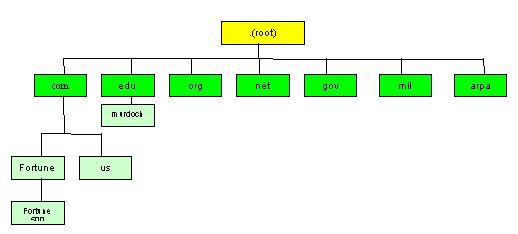
The current structure of the generic top level domains are
.com is for commerical organisations
.org is for non profit organisations
.mil is for the government military sites
.edu is for educational institutions such as universities and schools
.net is for networks
.gov is for the departments or agencies of goverments
References
Kristin Windbigler, 24 Jan 1997 Exploring the Domain Name Space [online], Availabe URL:
http://www.hotwired.com/webmonkey/webmonkey/geektalk/97/03/index4a.html
Charles L. Hedrick., 1987, Keeping track of names and information: the domain system [online], Available URL:
http://oac3.hsc.uth.tmc.edu/staff/snewton/tcp-tutorial/sec5.html
Al Berg, 1999, DNS DEMYSTIFIED TAKE THE MAGIC OUT OF MAPPING [ONLINE], AVAILABLE URL:
http://www.lantimes.com/handson/97/706a107a.html
IANA, 21 May 1999, Top Level Domain [online], Availalbe URL:
http://www.iana.org/domain-names.html
Question 2B
Question: "Explain the structure of generic top level domains as proposed by the Generic Top Level
Domain Memorandum of Understanding (gTLD-MoU). Discuss the merits of the proposal."
The Generic Top Level Domain Memorandum of Understanding (gTLD-MoU) is the international governance framework in
which policies for the running and improvement of the Internet's global Domain Name System (DNS) are developed and
implemented. For example, inter alia, the inclusion of new generic Top Level Domains (gTLDs) to the root of the DNS, selection
of registrars of new domain name, and creating fair procedures for dispute resolution over conflicts between parties
concerning rights to domain names. These policies are developed in cooperation with the Internet Assigned Numbers Authority
(IANA), who administers the root of the Domain Name System (DNS) to promote stability and robustness.
In developing policies, the gTLD-MoU policy framework tries to neutralise the many different interests of current
and future parties in the Internet DNS. Towards that objective, the MoU is designed to be open-ended and will
be improved and updated to new requirements.
.firm for businesses, or firms

.shop for businesses offering goods to purchase

.web  for entities emphasizing activities related to the World Wide Web

.arts for entities emphasizing cultural and entertainment activities

.rec  for entities emphasizing recreation/entertainment activities

.info for entities providing information services

.nom  for those wishing individual or personal nomenclature, i.e., a personal nom de plume

References


gTLD Mou, June 1 1998, gTLD Mou The proposed structure [online], Availabe at URL:

The proposed structure is at http://www.gtld-mou.org/docs/faq.html#2.1