(B) What is the format of IPv4 addresses in IPv6?
IPv6 addresses are 128-bit identifiers for interfaces and sets of
interfaces.  There are three types of addresses:

Unicast:   An identifier for a single interface. A packet sent to a unicast address is delivered to the interface identified by that address.

Anycast:   An identifier for a set of interfaces (typically belonging to different nodes).  A packet sent to an anycast address is delivered to one of the interfaces identified by that address (the "nearest" one, according to the routing protocols' measure of distance).

Multicast: An identifier for a set of interfaces (typically belonging to different nodes).  A packet sent to a multicast address is delivered to all interfaces identified by that address.

The IPv6 transition mechanisms [TRAN] include a technique for hosts and routers to dynamically
tunnel IPv6 packets over IPv4 routinginfrastructure. IPv6 nodes that utilize this technique are
assignedspecial IPv6 unicast addresses that carry an IPv4 address in the low-order 32-bits.  This
type of address is termed an "IPv4-compatibleIPv6 address" and has the format:

A second type of IPv6 address which holds an embedded IPv4 address is also defined.  This address
is used to represent the addresses of IPv4-only nodes (those that *do not* support IPv6) as
IPv6 addresses. This type of address is termed an "IPv4-mapped IPv6 address" and has the format:

Consists 128 bits (compared to32 bits for IPv4)

Using hexadecimal (based 16, or 4 bit) digits 0, 1, B, 9, A, E, F

Digits grouped in four to represent a 16-bit  (4 x 4 bits) numbers.

The address comprises of eight such 16 bit numbers, separated by colons. Eg:

99FA:8909:3A22:FA64:99FA:8909:2F22:CC99

Some parts may not be needed, and will be set to 0. Eg:

99FA:0000:0000:0000:99FA:8909:2F22:CC99

or

99FA:0:0:0:99FA:8909:2F22:CC99

Consecutive 0�s can be omitted and replaced by a double colon. Eg:

99FA::99FA:8909:2F22:CC99

If there are two sections in the address with consecutive 0�s, only one can be replaced by a double colon.
IPv6 will represent IPv4 addresses by keeping the decimal dot format, and tacking 0�s in the beginning. Eg.

194.128.23.80
becomes

::194.128.23.80
The Ipv4 before encapsulation is like this:
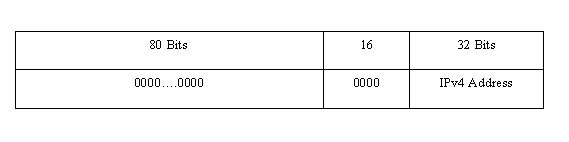
The Ipv4 encapuslated in Ipv6 format looks somethinglike this:

Home |
Question 1 |
Question 2 |
Question 3 |
Question 4 |
Question 4b |
Question 4c |
Comments |
References